



The revenue engine vs RevOps question usually comes up when growth slows and someone proposes a CRM project or a RevOps hire as the fix. The short answer: your revenue engine is the whole commercial system, from who you sell to through to how leaders run the number each week. RevOps is one part of it, the function that keeps the data, systems and reporting working. RevOps makes a sound engine faster and easier to see. It cannot choose your customers, repair a sales motion that doesn’t convert or stand in for weekly management. So a CEO’s first job is to find which part is failing, and only then decide whether RevOps is the fix.
In this article
- Revenue engine vs RevOps: the terms
- Symptoms that look like a RevOps problem
- A decision tree: what to fix first
- How CEOs should sequence the fix
- When RevOps should come first
- A 30-day starting point
Getting the order wrong is expensive. In a Gartner survey of 234 sales leaders (May to June 2024), sales organisations had been through an average of four transformations in two years, and only 11% had driven commercial success while executing one. In a separate Gartner survey of 1,026 B2B sellers in early 2024, 70% said they felt overwhelmed by the number of technologies they were expected to use. More change and more tools do not add up to a better engine.
Revenue engine vs RevOps: the terms
Our B2B revenue engine guide describes the engine as the connected system of strategy, people, processes, technology and management that turns market opportunity into repeatable revenue. It has six parts: customer focus (your ICP), the sales process, people and skills, revenue operations, leadership rhythm and revenue economics.
Revenue operations, or RevOps, runs the shared infrastructure underneath sales, marketing and customer success: CRM and tool administration, data quality, pipeline and forecast reporting, territory and quota mechanics, and the process plumbing that moves a lead through to a renewal. In most B2B software companies it reports into sales. ICONIQ’s 2026 research on go-to-market organisations, drawn from 150+ B2B software GTM leaders, finds sales is the typical home, with finance a less common alternative at companies with consumption- or outcome-based pricing.
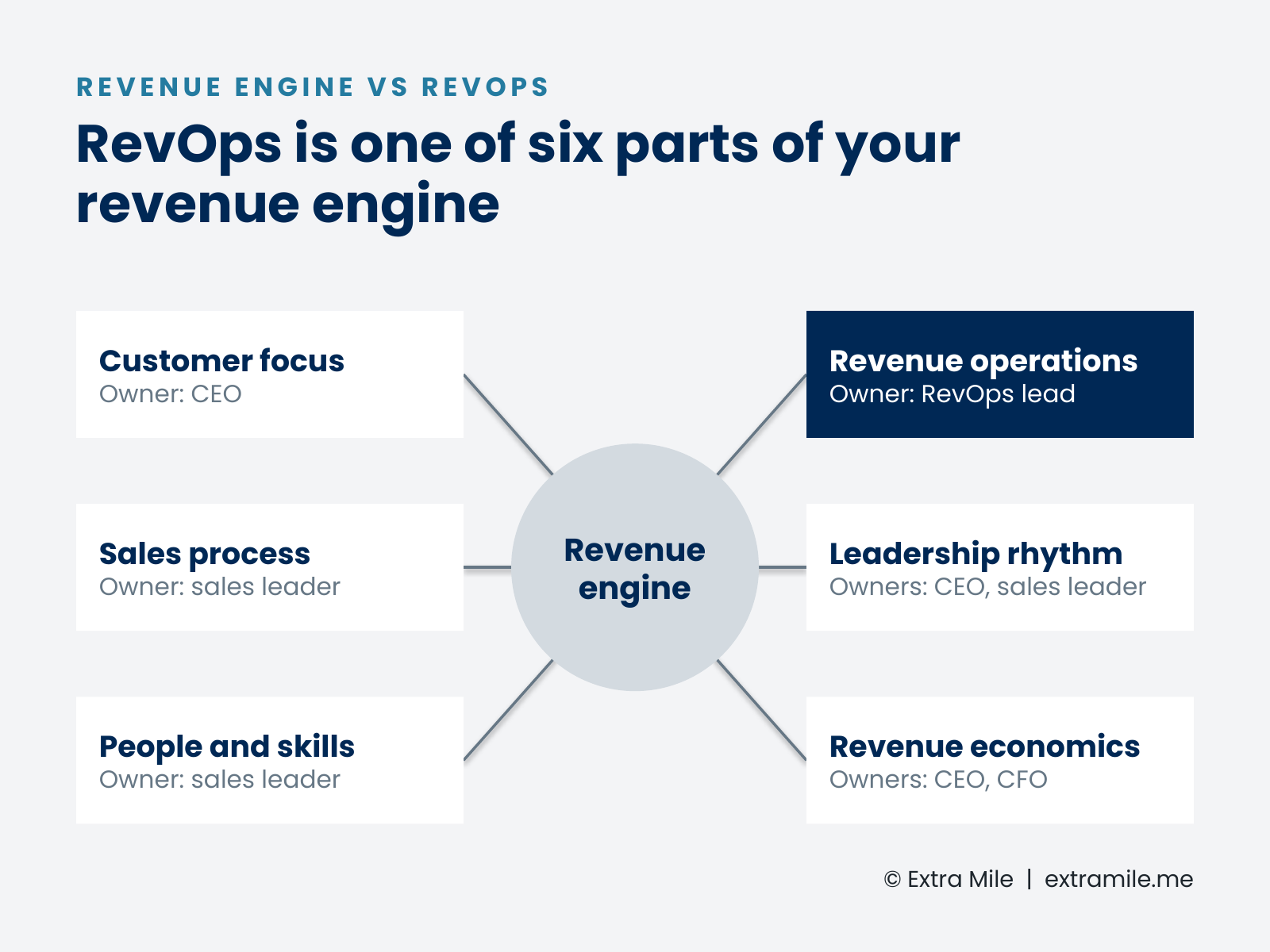
The difference matters because each part answers a different question, and a different person owns the answer. RevOps can show you that win rates have fallen in one segment. It cannot decide to stop selling to that segment. That call belongs to the CEO and the sales leader.
| Revenue engine | RevOps | |
|---|---|---|
| Scope | The whole commercial system | Data, systems, reporting and process plumbing |
| Core question | Are we winning the right customers, profitably and repeatably? | Can we see, measure and run the engine efficiently? |
| Usually owned by | CEO with the sales leader | RevOps lead, reporting to sales or finance |
| Typical fixes | ICP, sales motion, stages, hiring, management rhythm, pricing | CRM design, data quality, dashboards, routing, territories, automation |
| Can’t fix alone | Unreliable data and manual reporting | The wrong ICP, weak selling, missing management discipline |
Symptoms that look like a RevOps problem
Most requests for a CRM rebuild or a RevOps hire start with real pain. The trouble is that the pain shows up in the data, so the data takes the blame. Here are five common symptoms, and where the cause often sits:
- “We can’t trust our pipeline numbers.” Often a definition problem before it is a data problem. If nobody has agreed what a qualified opportunity is, or what must be true before a deal moves to proposal, a cleaner CRM will record the same disagreement more neatly.
- “The forecast swings in the last two weeks of the quarter.” Usually a management rhythm problem. Deals get reviewed for status rather than buyer evidence, and better dashboards don’t change the questions managers ask in the room.
- “Reps don’t use the CRM.” Sometimes a tooling problem. More often the CRM asks reps to log steps that don’t match how they sell, or nobody uses the data in reviews, so updating it feels pointless.
- “Win rates are falling.” RevOps can measure the drop. The cause tends to sit in who you target, how you qualify or how well people sell.
- “Growth still depends on the founder.” That is a people and handover question. Our guide to moving from founder-led sales to a sales team covers it in detail.
Data problems are real, and they cost money. In Validity’s State of CRM Data Management in 2026, a survey of 500 B2B and B2C marketers in the US, UK, Brazil, Australia and New Zealand, 62% of organisations reported losing revenue directly because of poor CRM data quality. That is vendor research, and Validity sells data-quality software. The question for a CEO is whether bad data causes the problem or is simply where the problem becomes visible.
A decision tree: what to fix first
Start from the symptom that costs you most, not the one that is easiest to buy a tool for. Then match it to the part of the engine that owns the cause.
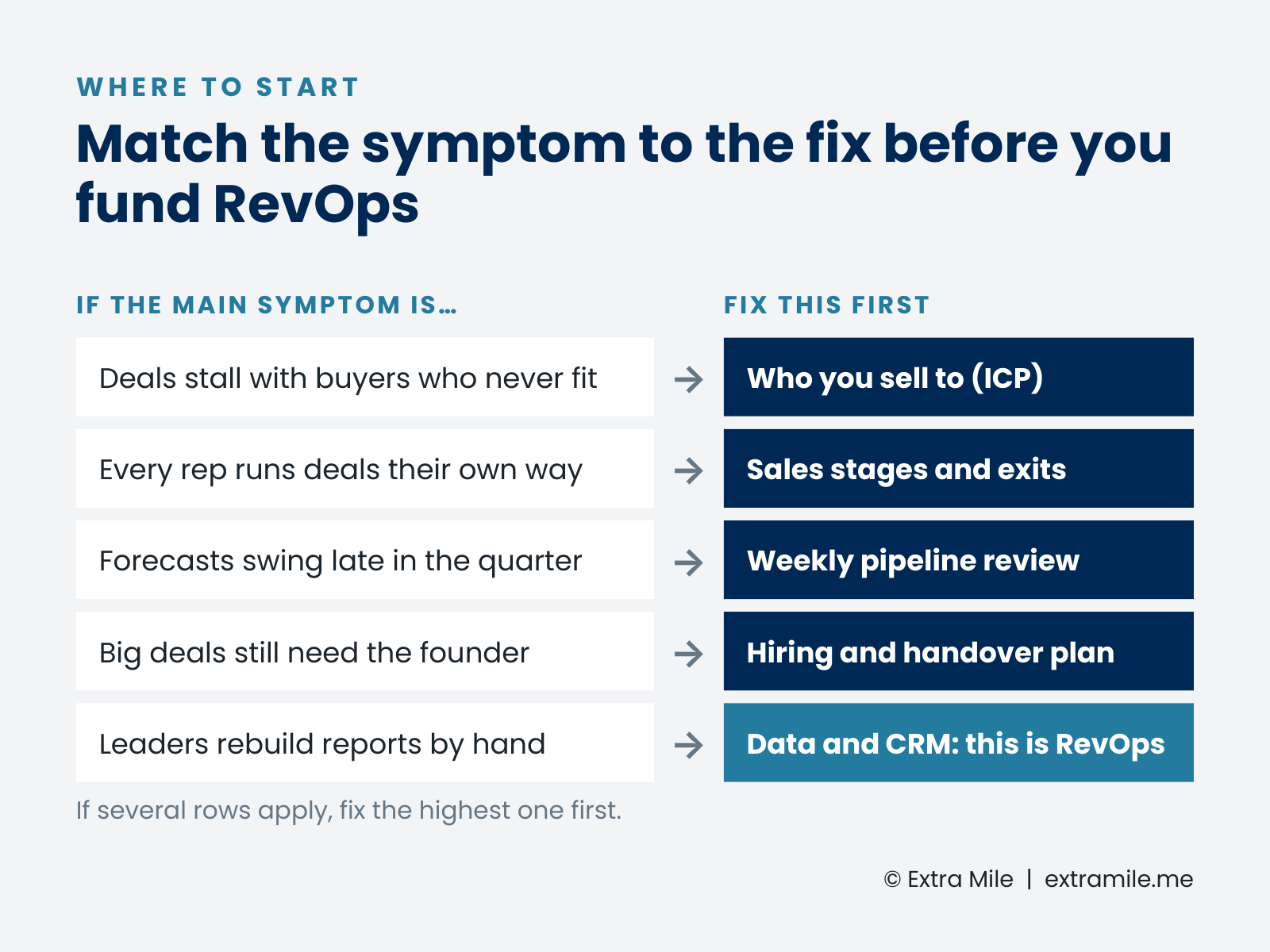
Two rules keep this honest. First, if more than one row applies, fix the higher one first. An ICP decision changes what your stages, reports and dashboards need to show, so building those before the decision means building them twice.
Second, if your data is too poor to show the symptom at all, do a minimum data fix before anything else: enough to count opportunities by stage, segment, source and owner for the last two or three quarters. That is a contained piece of RevOps work, far smaller than a CRM replacement, and it gives you the facts for every other decision.
How CEOs should sequence the fix
Once you know where the cause sits, sequence the work so each step makes the next one cheaper.
- Decide who you sell to and how. Confirm the ICP, the segments you will stop chasing and the sales motion for each. These are leadership decisions, and no amount of configuration can make them for you.
- Write the process down. Define four to six stages, each with exit criteria the buyer has to meet rather than activities the seller has completed. Agree one definition of a qualified opportunity across marketing and sales.
- Set the management rhythm. Run a weekly pipeline review that tests evidence against those exit criteria, a monthly forecast call and a quarterly reset. Choose the few numbers leaders will look at every week.
- Then build it into systems. RevOps now has something stable to encode: stage fields that match the exit criteria, required data at each stage, dashboards that mirror the review agenda, and automation that removes admin instead of adding it.
This order also protects your AI plans. In Salesforce’s State of Sales report (4,050 sales professionals in 22 countries, surveyed August to September 2025; vendor research), 51% of sales leaders using AI said disconnected systems were slowing their AI initiatives, and the average seller spent only 40% of their time selling. A Gartner survey of 227 chief sales officers in the same period found 31% named proving the return on AI-driven tools as a top challenge for 2026. AI tools sit on the same data and process as everything else. If the process is unclear, automation repeats the confusion faster. Our article on three AI sales workflows that save time without exposing customer data shows where AI helps once the basics are in place.
When RevOps should come first
Sometimes the bottleneck really is the operations layer. RevOps investment usually deserves to go first when:
- Your ICP, stages and review rhythm are agreed, but managers spend hours each week rebuilding reports in spreadsheets.
- Marketing, sales and customer success count pipeline, customers or revenue differently, and the argument is about definitions inside systems rather than strategy.
- You are adding sellers, territories or a new market, and lead routing, quotas and territories are still handled by hand.
- Renewal and expansion data sit outside the CRM, so you can’t see retention or expansion by segment.
In these cases a RevOps lead or a focused systems project pays back, because the decisions already exist and the work is to make them run reliably. Salesforce’s data points the same way: 79% of high-performing sales teams prioritise data hygiene, against 54% of underperformers. That is a correlation in self-reported survey data rather than proof of cause, but it fits the logic. High performers tend to treat clean data as part of how they manage.
A 30-day starting point for CEOs
You don’t need a large programme to find the real bottleneck. In the next 30 days:
- Pull the last three quarters of closed deals and compare won and lost by segment, source and the stage each deal reached.
- Sit in two pipeline reviews and note whether the questions test buyer evidence or seller activity.
- Ask three sellers to walk you through a live deal in the CRM, and note where the fields stop matching what they actually do.
- Write a one-page answer to two questions: who do we sell to, and what must be true before a deal moves forward? If the leadership team disagrees, start there.
Then decide. If the answers point to strategy, process or management, fix those before you fund a CRM rebuild. If they point to data and systems, RevOps is the right investment, and it will land faster because the decisions underneath it are clear.
If you’d like an outside view on where your bottleneck sits, discuss your revenue engine with Extra Mile. We start with a diagnosis, and a new CRM is rarely where it begins.
Sources and further reading
- Gartner: Only 11% of sales organisations drive commercial success while executing a transformation (December 2024)
- Gartner: 31% of CSOs cite difficulty proving ROI of AI-driven tools (May 2026)
- Salesforce: State of Sales report, 2026 (vendor research)
- Validity: State of CRM Data Management in 2026 (vendor research)
- ICONIQ: Building the modern GTM organisation, 2026 (investor research)