



An employee advocacy programme pays off for a B2B company in the UAE when it is run as a commercial programme: a sales or business leader owns it, a small cohort is chosen around target accounts, people are coached to start buyer conversations, the rules are clear, and results are reported in pipeline terms. Most programmes skip at least two of those decisions, which is why so many companies keep paying for LinkedIn reach while their own experts stay quiet.
In this article
- Why an employee advocacy programme usually stalls
- What is different in the UAE
- Step 1: Give the programme a commercial sponsor
- Step 2: Start with a small cohort tied to target accounts
- Step 3: Coach for conversations first
- Step 4: Set guardrails people can follow
- Step 5: Measure what sales can use
- Where to start
- Sources and further reading
This guide takes those five decisions in order and adds the local factors that matter in the UAE. If you are still deciding whether you need advocacy, social selling or executive influence in the first place, start with our comparison of employee advocacy vs social selling.
Why an employee advocacy programme usually stalls
The usual pattern is familiar. Marketing buys an advocacy tool, invites the whole company and sends a weekly queue of posts to reshare. Participation jumps in the first month, then fades. The posts that do go out are corporate updates that buyers scroll past, and the sales team never sees a link to its number.
The root cause is ownership and purpose. When a programme sits with communications alone, success gets measured in shares and impressions. Sales leaders see nothing they can use, stop encouraging their people, and the programme quietly becomes an employer-brand exercise.
Buyers are also raising the bar. The 2026 Edelman-LinkedIn B2B Thought Leadership Impact Report, based on more than 1,100 management-level professionals, finds that AI is putting a premium on original thinking, proprietary evidence and human judgement. Reshared brand copy offers none of those. A solutions architect explaining what actually went wrong on a migration offers all three.
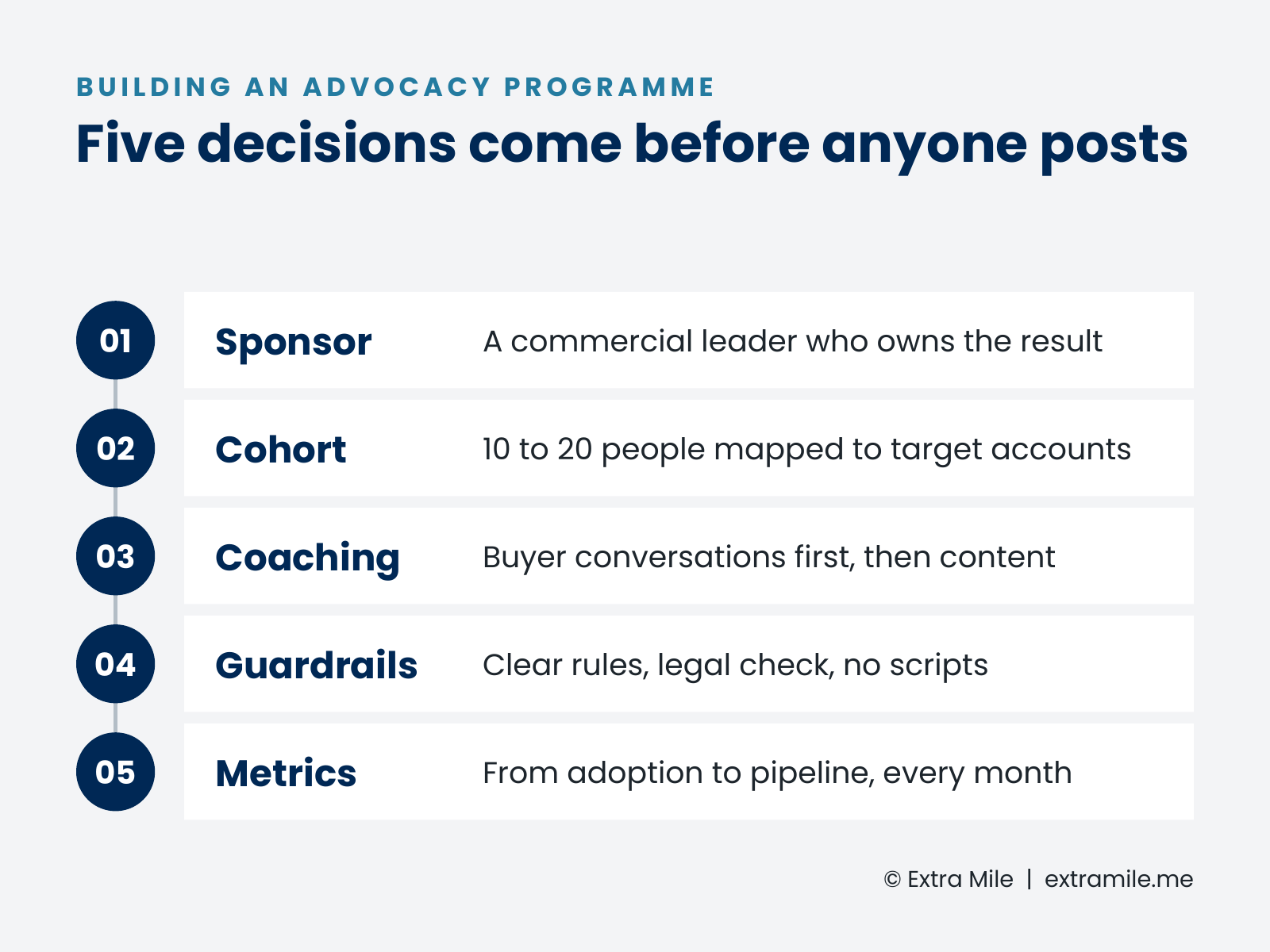
Each of those five decisions has to be made before anyone is asked to post. The rest of this guide takes them one at a time.
What is different in the UAE
UAE companies start from a stronger position than most. Gallup’s State of the Global Workplace 2026 puts employee engagement in the UAE at 27%, against 14% across the Middle East and North Africa and 20% globally. The UAE figure is a three-year rolling average, with the latest data collected in 2025.
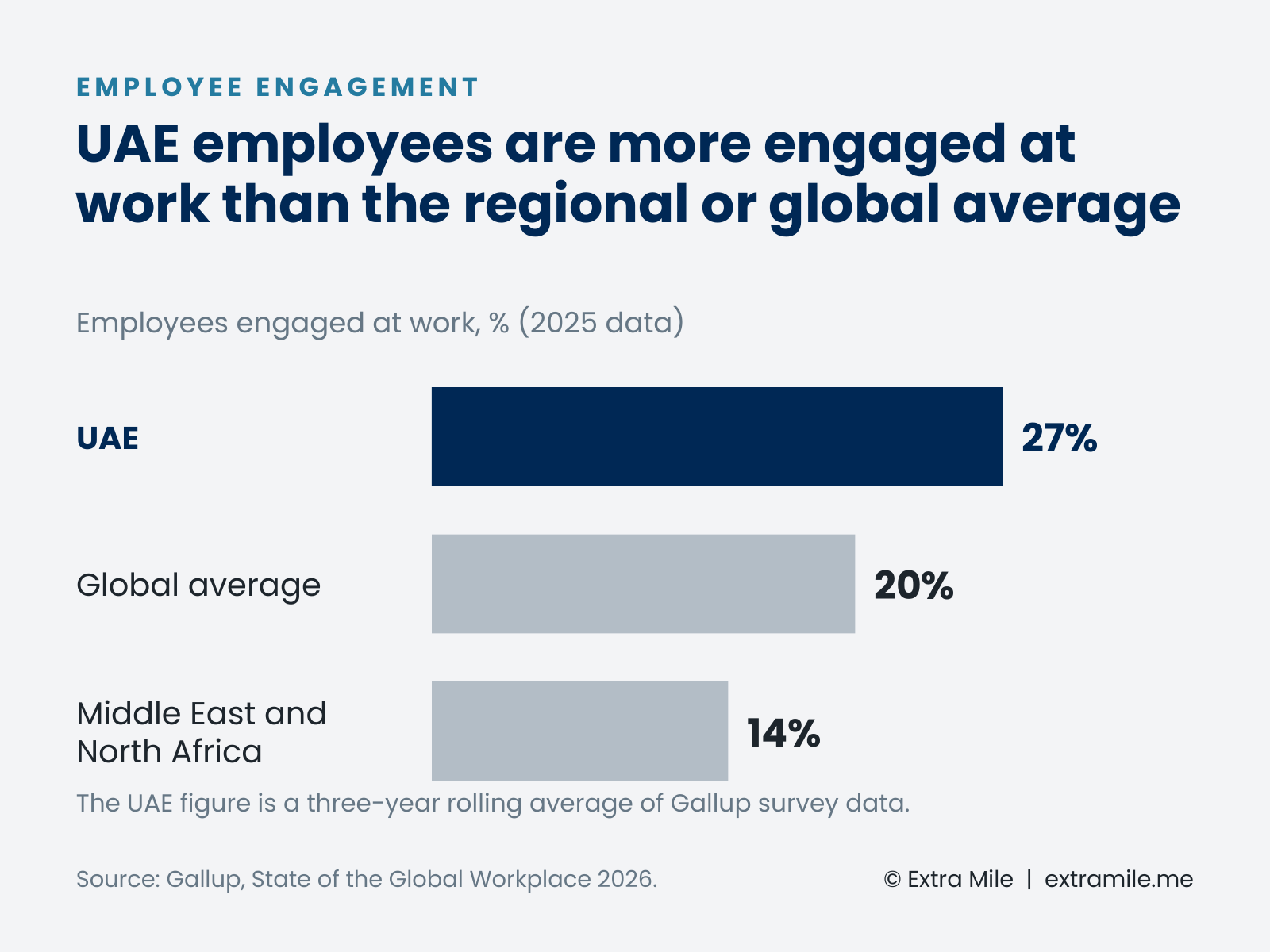
Engagement does not guarantee that anyone will post. It does mean many UAE firms can build a voluntary programme from a more willing pool than the global picture suggests.
Trust works in the same direction. In the 2026 Edelman Trust Barometer, nearly 34,000 people across 28 countries, including the UAE, were surveyed. Globally, 78% of employees trust their employer, while trust in business among the general population stands at 64%. Edelman’s UAE findings name employers and government as the institutions best placed to broker trust. People listen to colleagues and experts they know.
Two local factors shape the design. First, many UAE B2B teams bring together people from several countries, so their networks often reach former colleagues in other markets as much as buyers in Dubai or Abu Dhabi. Check where each person’s audience actually sits before assuming the reach is local. Second, the UAE has specific rules on promotional content on social media, covered under guardrails below.
Step 1: Give the programme a commercial sponsor
The sponsor should be the person who owns revenue for the accounts the programme targets: a Head of Sales, a CRO or the managing director of a business unit. Marketing still runs the programme day to day. The sponsor makes it matter.
In practice the sponsor does three things:
- Names the accounts, buyer roles and topics the programme should focus on.
- Takes part visibly, by posting, commenting and recognising good work.
- Reviews programme numbers in the same meeting as pipeline, not in a separate marketing update.
Marketing owns the content support, tooling and brand standards. HR and legal set the boundaries. If no commercial leader is willing to sponsor the programme, be honest about it: run it as an employer-brand initiative and measure it that way.
Step 2: Start with a small cohort tied to target accounts
A company-wide launch spreads effort thinly. Start with 10 to 20 people who already talk to buyers or hold expertise buyers ask about: account executives, solution consultants, practice leads, delivery leads and one or two executives. Credible volunteers beat a mandated roll-out.
Map each person to a slice of the target account list and the roles they should be visible to. That turns a vague instruction to “post more” into a clear brief: be useful to these 30 people. It is also the point where advocacy starts to overlap with what social selling looks like in practice, because visibility only matters if it leads to conversations.
Leave some people out of the first cohort: anyone without protected time, and anyone in a role where public comment carries regulatory or client risk. They can join once the rules are tested.
Step 3: Coach for conversations first
One workshop followed by silence is the most common way these programmes fail. The same pattern explains why LinkedIn training fails without manager reinforcement: behaviour changes when managers keep asking about it.
A workable rhythm for the first three months looks like this:
- Reset each profile so it speaks to the buyer’s problem, not the person’s job history.
- Hold short fortnightly sessions where each participant brings one question a buyer asked recently and turns it into a post or a useful comment.
- Have managers review conversations started, not posts published, in their one-to-ones.
Position the programme as career development as well as a commercial effort. LinkedIn’s 2025 Workplace Learning Report, which is vendor research, finds that career progress is people’s main motivation to learn, yet only 15% say their manager helped them build a career plan in the past six months. Building a visible professional reputation gives managers a concrete development conversation to have.
Step 4: Set guardrails people can follow
People hold back when they are unsure what they are allowed to say. A one-page policy fixes most of that. It should cover what can be shared (personal expertise and published company material), what cannot (client names, deal details, pricing and anything under a confidentiality agreement without approval), how to handle a comment that turns into a complaint, and who reviews claims in regulated areas.
Approve topics, not wording. Scripted posts read as scripted, and buyers notice.
UAE companies also need to check one specific rule. In July 2025 the UAE Media Council announced an Advertiser Permit for people who publish promotional content on social media, whether the content is paid for or not. The published exemption covers individuals promoting their own products or a company they own. Public guidance does not spell out how ordinary expert posts by employees are treated, and law firm Al Tamimi advises businesses to confirm that employees engaged to publish advertising content hold a valid permit. Before you offer incentives or ask staff to publish anything that reads like an advert, get your legal team’s view. This article is not legal advice.
Step 5: Measure what sales can use
Likes and impressions are easy to count and hard to defend in a budget review. Report the programme monthly as a ladder, from activity at the bottom to pipeline at the top, and judge it on how far up the ladder it climbs over a quarter.
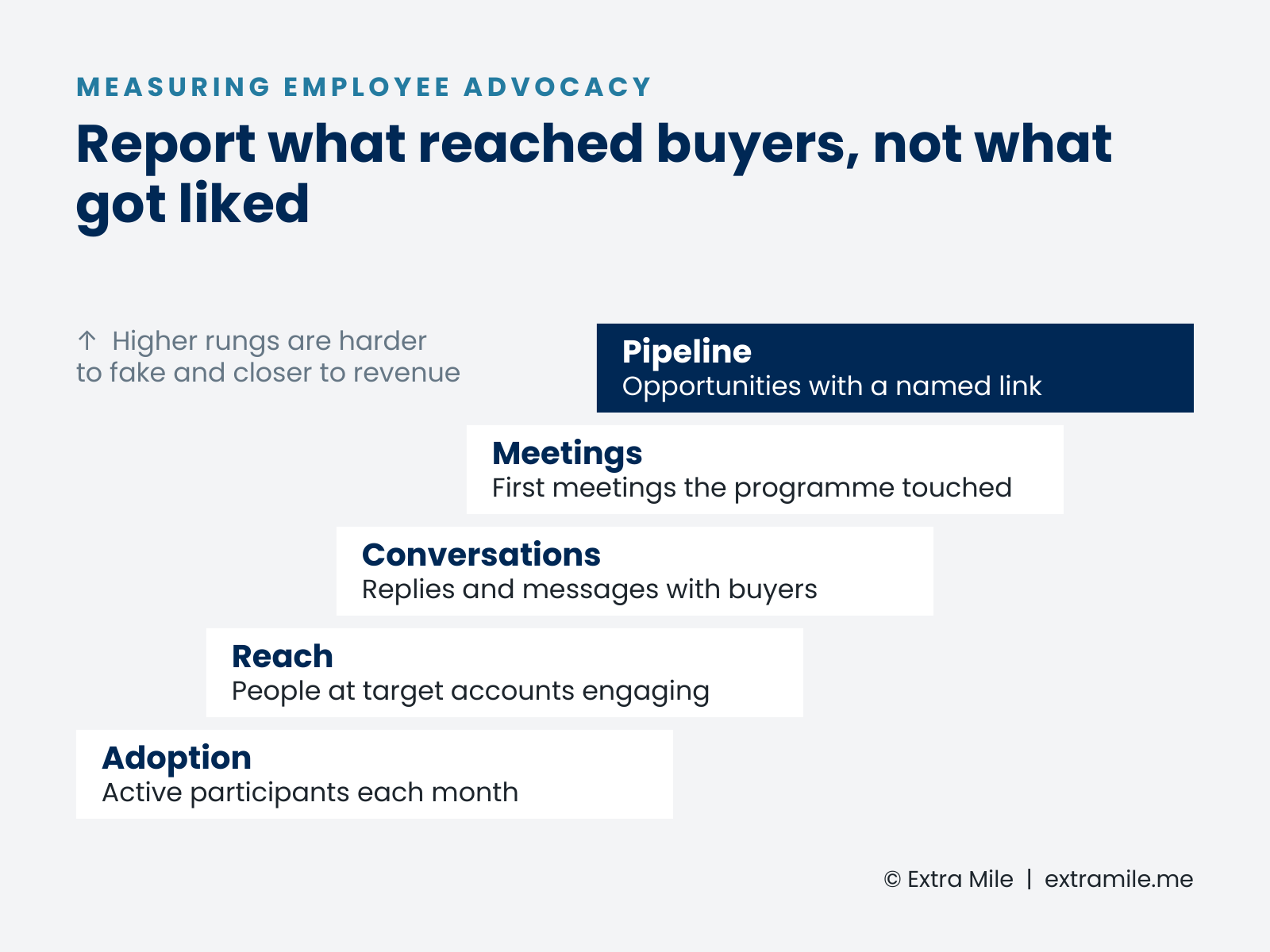
Be careful with attribution. B2B deals involve many people and many touches, so an advocacy programme rarely sources a deal on its own. Record a named link instead: an opportunity where someone at the account engaged with a cohort member before or during the deal. A simple CRM field is enough. Agree the definition with finance before the first report, so nobody argues about it later.
Adoption still matters at the bottom of the ladder. If fewer than half the cohort is active by the second month, fix coaching or time allocation before you worry about pipeline.
Where to start
Run the first cohort as a one-quarter pilot. Agree the sponsor, the accounts and the five measures before launch, then decide at the end of the quarter whether to scale, adjust or stop. A small programme that produces named conversations with target accounts is a far stronger case for investment than a large one that produces impressions.
If you want help designing the sponsor model, cohort and coaching rhythm for your team, discuss Commercial Activation with Extra Mile.
Sources and further reading
- Gallup, State of the Global Workplace 2026: United Arab Emirates country-level data
- Edelman Trust Institute, 2026 Edelman Trust Barometer: UAE
- Edelman, 2026 Edelman Trust Barometer global press release (January 2026)
- Edelman and LinkedIn, 2026 B2B Thought Leadership Impact Report
- LinkedIn Learning, 2025 Workplace Learning Report (vendor research)
- The National, UAE launches advertiser permit for social media users (July 2025)
- Al Tamimi & Company, UAE Advertiser Permit: applicability for sole establishments only (October 2026)