



Few international B2B companies set up in Dubai or Riyadh to sell into one country. They open a base there to sell across the Middle East, and often into North Africa and further into Africa too. That makes your Middle East route to market a regional decision with two parts: where your hub sits, and how you sell into each market from it, whether through direct sales, distributors or partners. The short answer is to let each market’s buying habits choose the route, and to test before you sign anything exclusive.
In this article
- Region first, then the hub
- The three routes
- A different route for each market
- How to choose
- Rules to check before you sign
- Validate a partner first
- Failure signs
- Making the decision
- Sources and further reading
Start with the region, then choose the hub
Commercially, the Middle East is a set of quite different markets. The six Gulf states (the UAE, Saudi Arabia, Qatar, Kuwait, Bahrain and Oman, often grouped as the GCC, the Gulf Cooperation Council) usually come first. Egypt, Jordan and Lebanon follow for many sellers. Many Dubai-based teams also cover Morocco, Algeria and Tunisia, and some sell into East and South Africa. Language, procurement, regulation and buying habits change from one market to the next.
Most companies choose a hub in the UAE or Saudi Arabia first. We compare the two in UAE vs Saudi Arabia: where B2B SaaS companies should enter first, and our guide to Gulf market entry for B2B companies covers demand validation and when to set up locally. This article starts once the hub is chosen.
The hub still shapes your routes. If you plan to sell to Saudi government entities, for example, the US International Trade Administration’s Saudi public sector guide (May 2026) notes that since 1 January 2024, companies eligible for a regional headquarters that have not set one up in the Kingdom cannot take part in tenders or contracts with Saudi government entities.
Three routes to market in the Middle East
- Direct sales. Your own people sell, price and contract, from your hub or from abroad. In the early months this is often the founder or a senior seller.
- Distributors and resellers. A local company buys from you or resells under its own contract, invoices the customer and often provides first-line support. A registered commercial agent is a specific, legally protected version of this.
- Referral and co-sell partners. Consultancies, system integrators and technology partners introduce or influence deals while you sell and contract. Implementation partners also deliver the work after the sale.
Partners shape far more deals than they sign. Omdia, the analyst firm that now includes Canalys, estimates that the channel’s share of global technology spend fell from 69% in 2025 to 65% in 2026, yet “well over 90%” of technology purchases are assisted by partners in some way, as reported by Channel Dive in July 2026. These are global figures. Even if you sell direct, someone in your buyer’s circle probably advises on the purchase.
Each route trades speed and cost against control. A distributor can get you selling sooner and cheaper but owns the customer relationship; direct sales keep control of price and data but take longer to build in every new country.
Use a different route for each market
A regional plan rarely uses one route everywhere. Direct selling tends to make sense in the hub country and for a short list of strategic accounts in the region’s other large market. Smaller markets may not justify a dedicated seller, so a co-sell partner or reseller who already works there can carry the load. Further afield, local invoicing, language and after-sales support can matter more than control.
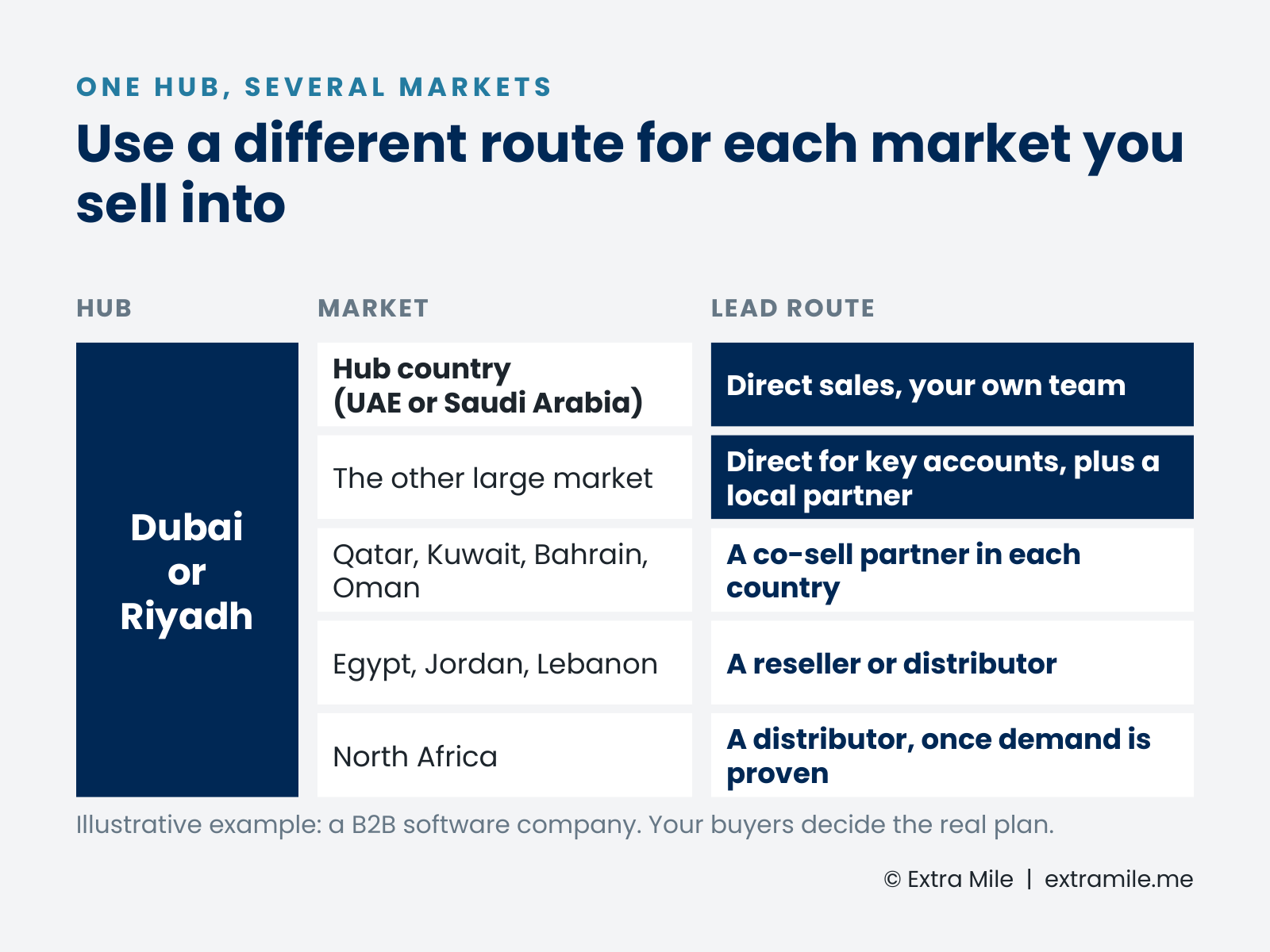
Treat a plan like this as a starting hypothesis. Your own conversations with buyers in each market should overrule it, and the order matters: prove one market before you sign partners in five.
How to choose your Middle East route to market
Ask these five questions for each market, not once for the region:
- How do target accounts there buy today? Ask a handful of them whether they buy software or services like yours from the vendor, through a reseller or integrator, or from an approved supplier list.
- Who has to deliver and support locally? If customers expect on-site implementation or Arabic-speaking support you can’t yet provide, someone else must.
- What do your deals look like? A few large, complex deals can justify senior direct selling from the hub. Many smaller deals favour a partner who already reaches those buyers.
- How much control do you need? Pricing, positioning and customer data are harder to protect when another company owns the contract.
- How easily can you change course? Some arrangements are simple to end. Others, as the next section shows, are not.
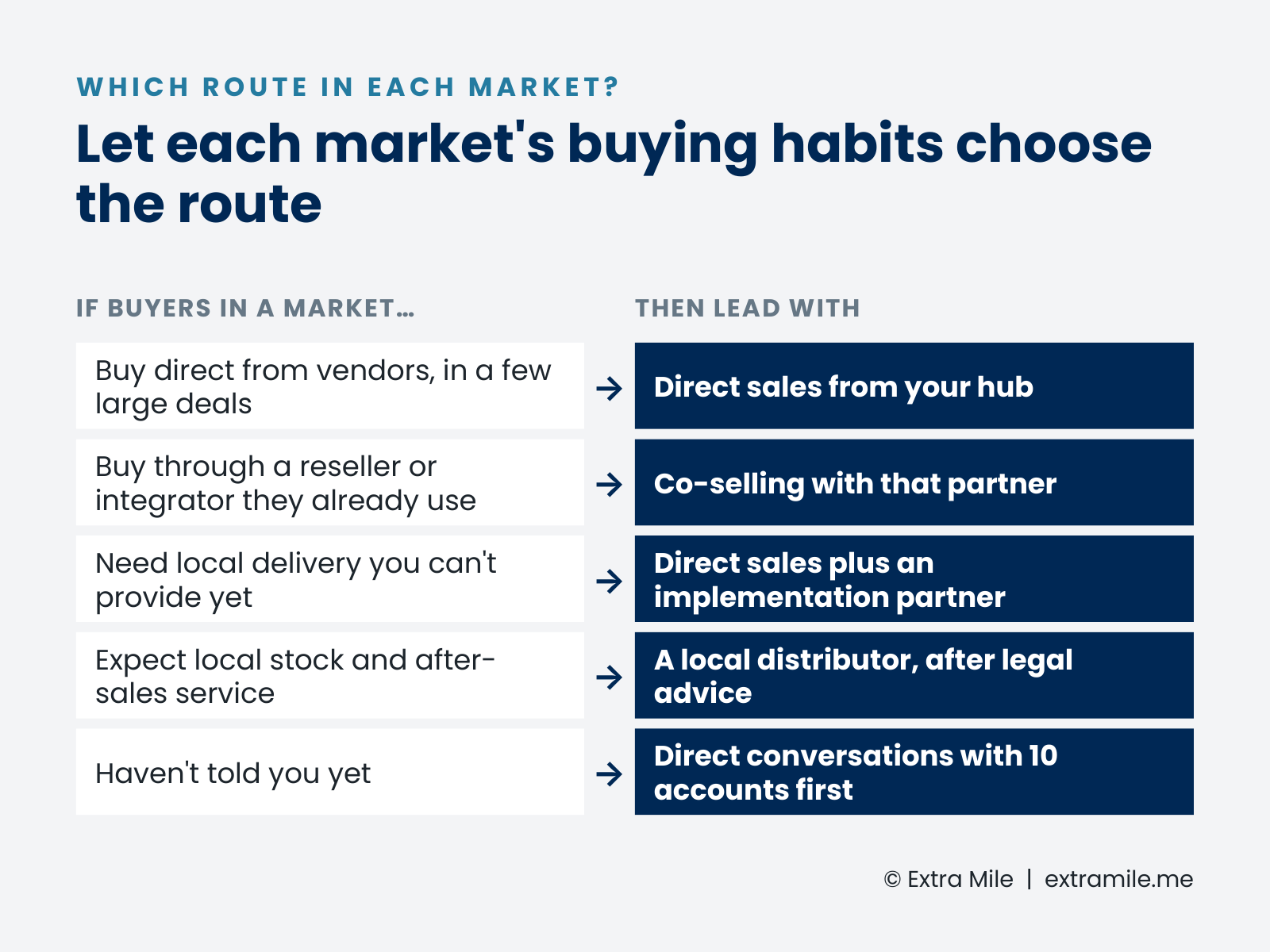
When both routes run in the same market, decide early who owns each named account. Most channel conflict starts there.
Rules to check before you sign anything
Every country has its own company, agency and procurement rules. These points most often change the choice in the two usual hubs. This is a summary to help you ask the right questions, not legal advice: take local advice in each market before you commit.
United Arab Emirates
By default, a free zone company is not permitted to carry out business outside its free zone without permission and a licence from the emirate’s economic department. In Dubai, Executive Council Resolution No. 11 of 2025 lets free-zone-licensed companies operate in mainland Dubai with a licence or permit from the Department of Economy and Tourism. Federal Law No. 3 of 2022 on commercial agencies requires agencies to be written, notarised and registered; registered agents are generally UAE nationals or companies wholly owned by them; an agency can be exclusive for the country or per emirate; and ending one generally needs at least a year’s notice, with possible compensation.
Saudi Arabia
The US International Trade Administration’s Saudi distribution guide (May 2026) says foreign exporters are not required to appoint a local agent or distributor to sell to Saudi companies, but recommends a Saudi service agent for government business. Agency and distribution agreements fall under Ministry of Commerce regulations, should be registered, and agents may ask for compensation when the relationship ends. Add the regional headquarters rule above if public-sector buyers are part of your plan.
The practical lesson is the same everywhere: do not grant exclusivity, least of all region-wide exclusivity, before a partner has proved it can produce pipeline.
How to validate a partner before you commit
A signed partner agreement does not create pipeline on its own. Good partners carry several vendors and decide each week where their sellers spend time, and vendors are competing harder for that attention: in PartnerStack and Wynter’s survey of 100 senior leaders at B2B SaaS companies above $50M, published in September 2025, 69% said they plan to increase investment in partnerships. That is vendor research on larger SaaS firms, mostly outside the region.
Before you commit, check five things:
- Account access. Share your list of target accounts and ask which ones the partner actively sells into, and who they know there.
- Real coverage. A partner that claims the whole Middle East should show customers and staff in each country it names.
- Comparable sales. Ask what they have sold in your category in the last year, and speak to two of those customers.
- Named capacity. Find out who will sell and who will deliver, and how much of their time is realistically yours.
- Conflicts. Ask which competing products they carry and how they decide what to lead with.
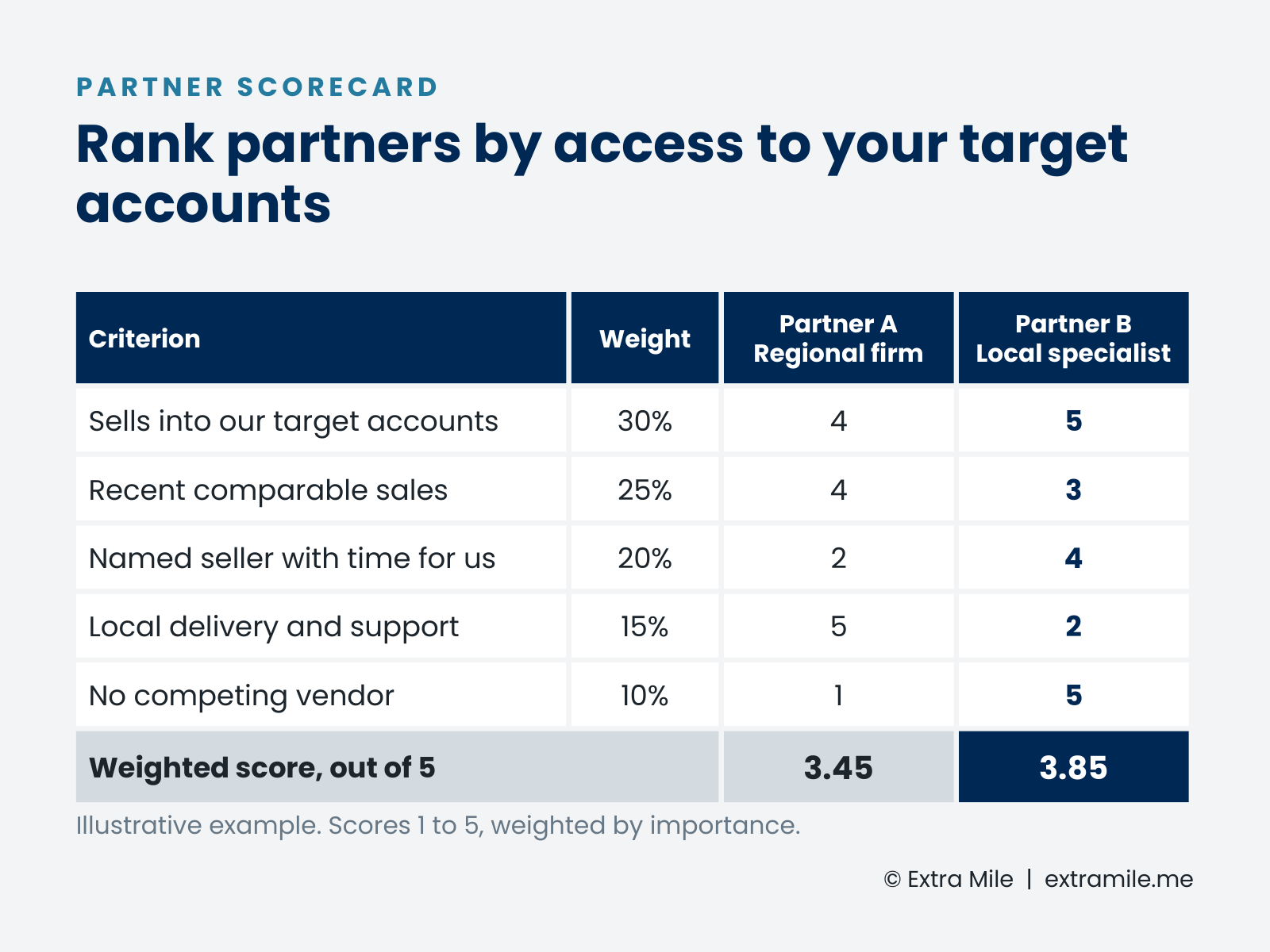
Weight the criteria by what buyers in that market need, then run a short, non-exclusive test with named accounts and a target for qualified meetings agreed in advance. If Dubai is your hub, build the test into the first 90 days of UAE market entry, alongside your own direct conversations, so you can compare routes on evidence.
Failure signs to watch in the first six months
- The agreement is signed, but after a quarter there are no named opportunities.
- You cannot name the buyers in the partner’s pipeline, or speak to them.
- A “regional” partner produces deals in its home country only.
- The partner asks for exclusivity or a bigger margin before showing results.
- Every customer conversation runs through the partner, so you learn nothing about objections, pricing or competitors.
- Your direct sellers and your partners chase the same accounts with no agreed rules of engagement.
None of these means the region is wrong. They usually mean the route, the partner or the market order needs to change. Review them monthly, market by market.
One hub, the right route for each market
The right Middle East route to market is a set of choices: a hub that fits where your accounts and public-sector rules sit, and a route for each market that matches how its buyers already buy. Start direct, test one or two partners against a scorecard, keep exclusivity off the table until results arrive, and take local legal advice before signing anything that is hard to undo.
If you are planning how to sell across the region from Dubai or Riyadh, Extra Mile helps international B2B companies test routes to market with real buyers before they commit. Discuss your Middle East expansion.
Sources and further reading
- US International Trade Administration: Saudi Arabia Country Commercial Guide, Selling to the Public Sector (2026)
- US International Trade Administration: Saudi Arabia Country Commercial Guide, Distribution and Sales Channels (2026)
- UAE Government: Federal Law No. 3 of 2022 on Regulating Commercial Agencies
- UAE Government portal: Running a business in a free zone
- Dubai Media Office: Resolution regulating free zone establishments operating outside designated zones (March 2025)
- PartnerStack and Wynter: The State of Partnerships in GTM 2026 (vendor research, September 2025)
- Channel Dive: The channel owns less than two-thirds of global IT spend (Omdia data, July 2026)