



AI for sales has reached almost every revenue team, but the payback has not. The teams that see a return start with a short list of frequent, low-risk workflows that run on data they already hold. They keep a person in charge wherever a buyer is affected, and they decide in advance where the saved time will go. This guide sets out six workflows worth automating first, the tests to rank them and a measurement plan that shows whether any of it is paying off.
In this article
- Why AI for sales stalls after the pilot
- Three readiness tests before you automate
- Six workflows worth automating first
- Risk controls that keep a person in charge
- Give every workflow an owner
- How to measure AI for sales
- What to expect in 2027
- Sources and further reading
Why AI for sales stalls after the pilot
The gap between using AI and getting value from it is wide. In Salesloft’s 2026 US Revenue Benchmark, every one of the 500 US sales and revenue decision-makers surveyed said they use AI somewhere in the revenue process. Only 20.6% described their AI strategy as production-ready with measurable outcomes. That is vendor research, self-reported and US only.
The time saving is real, yet it leaks away. A Gartner survey of 210 chief sales officers and senior sales leaders, run in January and February 2026, found AI saves sellers an average of 4.8 hours a week. But 72% of sales organisations reported low reinvestment of that time into high-value selling. Results are uneven too: a quarter of the organisations reported a return of 50% or more on their AI investment, while a fifth reported a negative return of 50% or more.
Proving the return is now a leadership problem. In a separate Gartner survey of 227 CSOs (August to September 2025), 31% named difficulty proving the ROI of AI-driven tools as a top challenge for 2026.
The pattern behind these numbers is familiar. Tools are bought before anyone decides which workflow they are for, who owns it or what should happen to the hour it frees up. AI then sits on top of a sales process that was never clearly defined. That is why AI belongs inside a wider view of what a B2B revenue engine is, not in a separate tools budget.
Three readiness tests before you automate
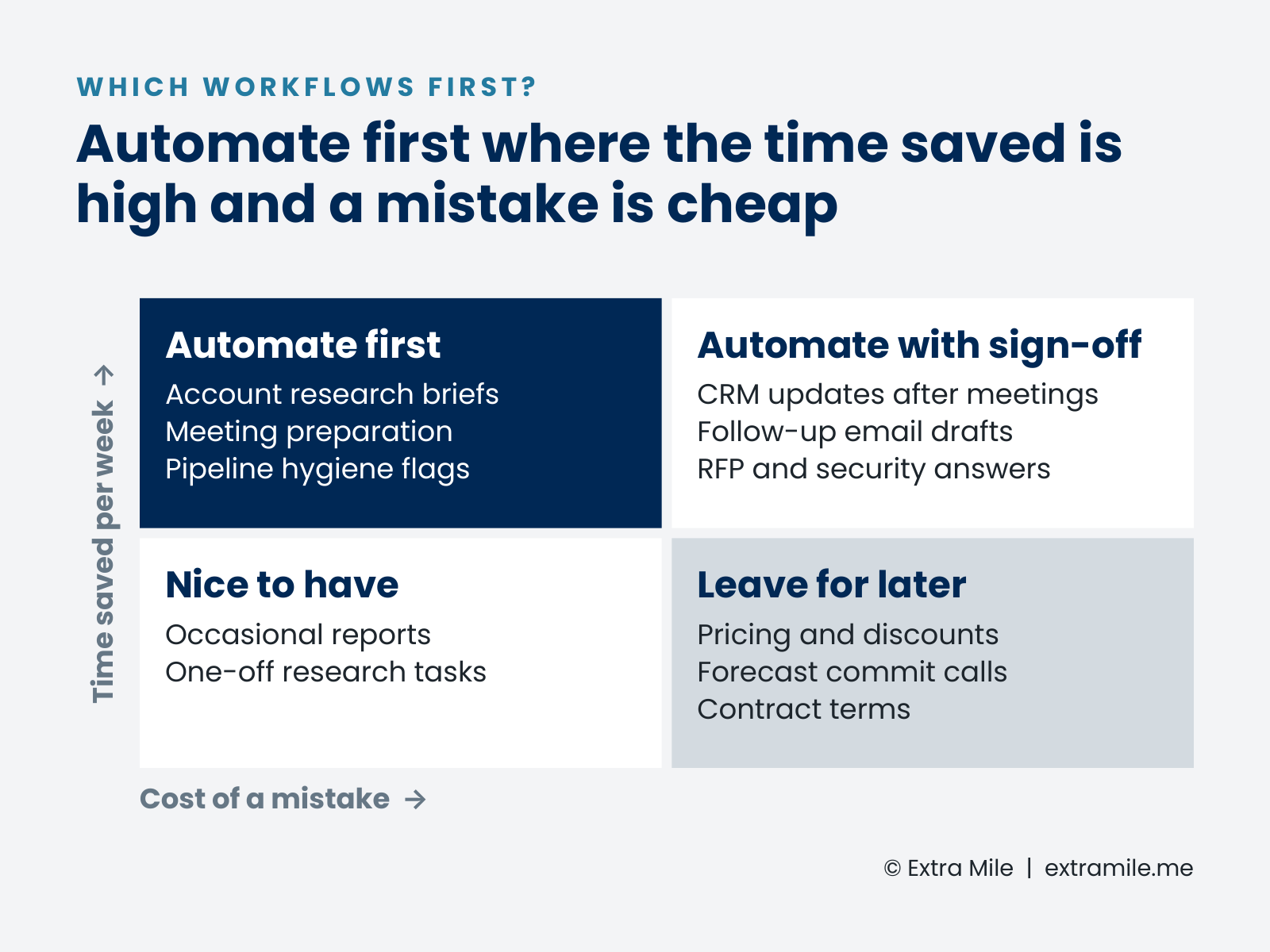
Rank each candidate workflow on three tests before buying or building anything.
- Time saved: how often the task happens, multiplied by the minutes it takes. A 20-minute task every seller does ten times a week beats a two-hour task done once a quarter.
- Adoption: whether the AI step sits inside something sellers already do. A summary that appears in the CRM record they already open gets used. A separate tool they have to remember to visit usually does not.
- Data readiness: whether the inputs exist and are good enough. If a workflow needs clean CRM history and your CRM is mostly seller opinion, fix the data first or pick another workflow.
Then apply one filter: what happens if the output is wrong? An inaccurate internal research brief costs a seller a few minutes. An inaccurate price, contract term or email sent in a seller’s name costs trust with a buyer.
Data readiness is where most small teams trip. In the Salesloft survey, 55.6% of respondents said the information entered into their CRM is based mostly on subjective seller reporting. Salesforce’s 2026 State of Sales found 51% of sales leaders using AI say disconnected systems are slowing their AI initiatives (vendor research, 4,050 sales professionals in 22 countries, surveyed in 2025).
Six workflows worth automating first
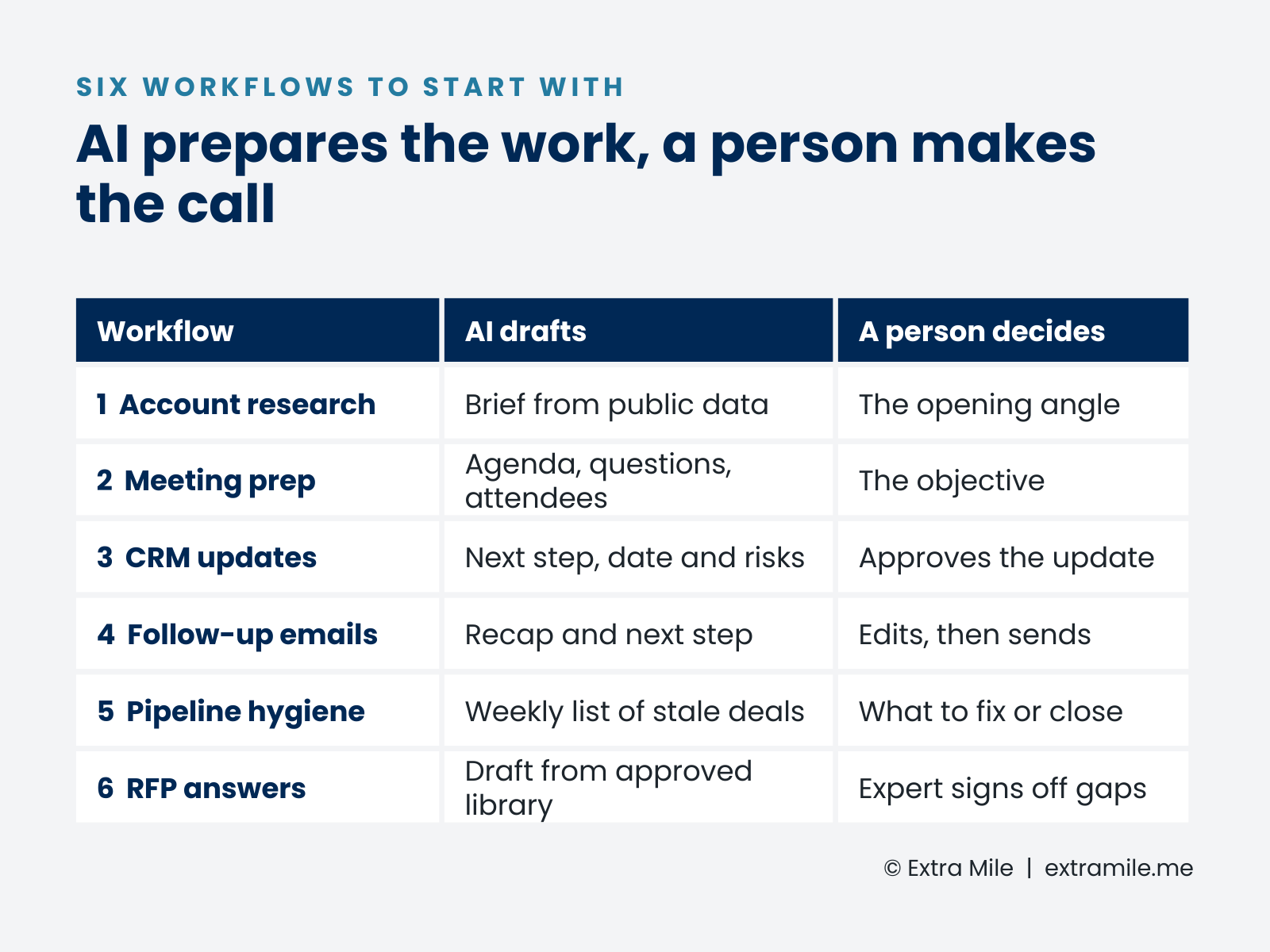
These six score well on all three tests for most B2B teams of three to 30 sellers. In each one, AI prepares the work and a person makes the decision.
1. Account research briefs
AI pulls public information, such as company news, annual reports, hiring and stated priorities, into a one-page brief before first outreach. The seller checks the facts and chooses the opening angle. Because it uses public data only, the risk is low. Our guide to AI sales workflows that protect customer data sets out the steps and what to keep out of the prompt.
2. Meeting preparation
AI turns approved CRM history and the research brief into a draft agenda, likely questions and a list of who has been involved so far. The seller sets the objective for the meeting. It is one of the cheapest ways to raise meeting quality without adding preparation time.
3. CRM updates after meetings
AI turns approved notes or a call summary into structured fields: next step, date, people involved and open risks. The seller approves the update before anything is saved. Updating CRM records was the most-cited admin bottleneck in the Salesloft survey, named by 37.6% of respondents, so this is often where hours come back first and where forecast data starts to improve.
4. Follow-up email drafts
Within an hour of the meeting, AI drafts a recap and a proposed next step for the seller to edit and send. It should never send on its own. Speed matters, but so does the buyer recognising the conversation they actually had.
5. Pipeline hygiene flags
Before the weekly pipeline review, AI and a few simple rules flag deals with no next step, close dates in the past or no activity for two weeks, with a one-line summary of each. The manager decides what to fix, push or close. The risk is low because nothing leaves the business.
6. RFP and security questionnaire drafts
For software and technology sellers, questionnaires can eat days. AI matches each question to an approved answer library, drafts a response and flags questions with no approved answer. A subject-matter expert signs off the gaps. Without a maintained library, skip this one until you have it.
Notice what is missing. Autonomous outbound at volume, pricing and discount decisions and the forecast number itself all fail the cost-of-a-mistake filter: an error reaches a buyer or the board before anyone sees it. They can come later, once the first six are running and measured.
Risk controls that keep a person in charge
Keep controls light enough that sellers still use the workflows. For most teams, five rules cover it:
- Use only approved tools, connected to the minimum data each workflow needs.
- Keep customer-confidential information out of any tool not approved for it.
- Require a person to approve anything that reaches a buyer or changes the forecast.
- Record which workflow produced which output, so errors can be traced.
- Review the rules every quarter as tools and contracts change.
Before connecting any tool to your CRM or inbox, check its data retention and access settings with whoever owns security and legal in your business. Vendor assurances help, but they do not remove the need to check.
Give every workflow an owner
AI workflows fail quietly when nobody owns them. Name one business owner per workflow, usually the head of sales or whoever runs sales operations, rather than IT. The owner decides the approved data, the review step, the metric and what the saved time is for.
That last decision is the one most teams skip. In the same Gartner survey, sales organisations that saved moderate to large amounts of time and reinvested it were 2.2 times more likely to exceed customer growth goals than those that reinvested less. It is an association rather than proof of cause, but saved time that is not redirected tends to disappear into email and admin.
Agree the reinvestment rule before the pilot starts. For example, hours saved on CRM updates go into two extra first meetings per seller per month, tracked in the weekly pipeline review.
How to measure AI for sales
Measure each workflow on net time saved, quality and where the time went. Here is a four-step plan for one workflow, CRM updates after meetings.
- Baseline (week 0): record how long the CRM update and follow-up take today, and what share of open deals has a dated next step.
- Pilot (weeks 1 to 4): three sellers use the workflow after every meeting.
- Net saving (week 5): minutes saved, minus the time spent reviewing and correcting the AI’s output. If review eats more than half the saving, redesign the workflow or stop.
- Reinvest (week 6 onwards): book the saved hours into the agreed selling activity and check each week that it happens.
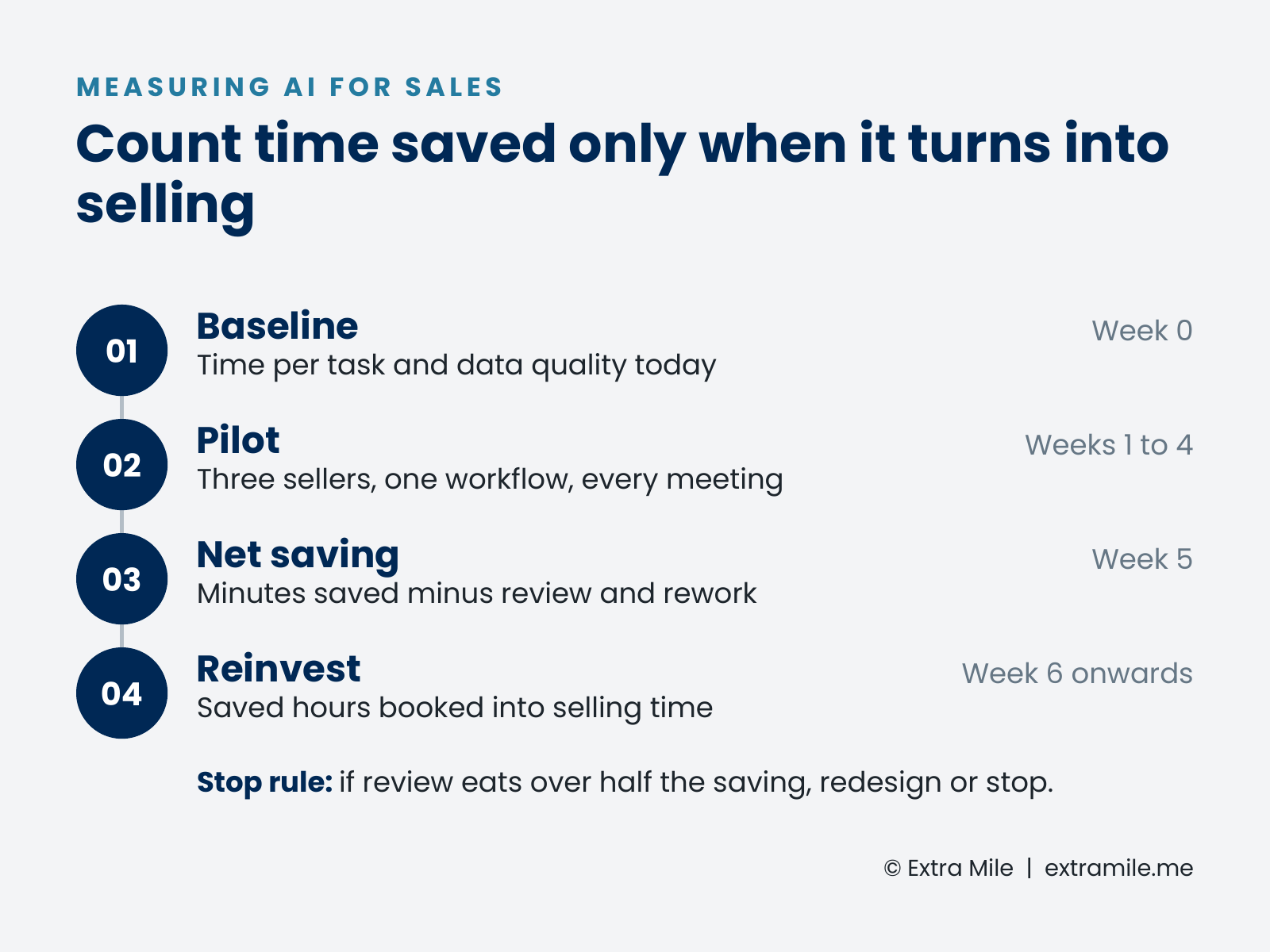
Track three numbers for this example: minutes per update, the share of deals with a dated next step and first meetings per seller. The first shows the efficiency gain. The second shows whether data quality improved. The third shows whether the time became selling.
What to expect in 2027
Adoption will keep rising. In Salesforce’s 2026 survey, 54% of sellers said they had used AI agents and nearly nine in ten planned to by 2027. Those are plans, not outcomes. McKinsey’s State of AI 2026 found nearly nine in ten respondents report regular AI use in at least one business function, yet only 37% attribute any EBIT impact to it. Where revenue gains are reported, they are most often attributed to AI in marketing and sales.
Buyers are changing as well, with AI starting to shape how they research and shortlist vendors before speaking to sales. Our view of AI agents in B2B buying covers what sales teams should prepare for on that side.
Our outlook for 2027 is fewer, better-run workflows rather than more tools. Teams that pick six, measure them and redirect the time will have results to show. Teams that add agents to an undefined process are likely to see more activity and the same numbers.
If you want a second view on which workflows to start with and how they fit your sales process, discuss your revenue engine with Extra Mile.
Sources and further reading
- Gartner (19 May 2026). Gartner Survey Finds AI Saves Sellers Nearly 5 Hours Per Week Yet 72% of Sales Organizations Fail to Reinvest Time in High-Value Activities. Survey of 210 CSOs and senior sales leaders, January to February 2026.
- Gartner (19 May 2026). Gartner Survey Shows 31% of Chief Sales Officers Cited Difficulty Proving ROI of AI-Driven Tools. Survey of 227 CSOs, August to September 2025.
- Salesloft (September 2026). 2026 US Revenue Benchmark Report. Vendor research, 500 US sales and revenue decision-makers.
- Salesforce (February 2026). State of Sales, 7th edition. Vendor research, 4,050 sales professionals in 22 countries, August to September 2025.
- McKinsey (August 2026). The state of AI in 2026: On the road to ROI. 1,719 participants in 97 countries, May to June 2026.