



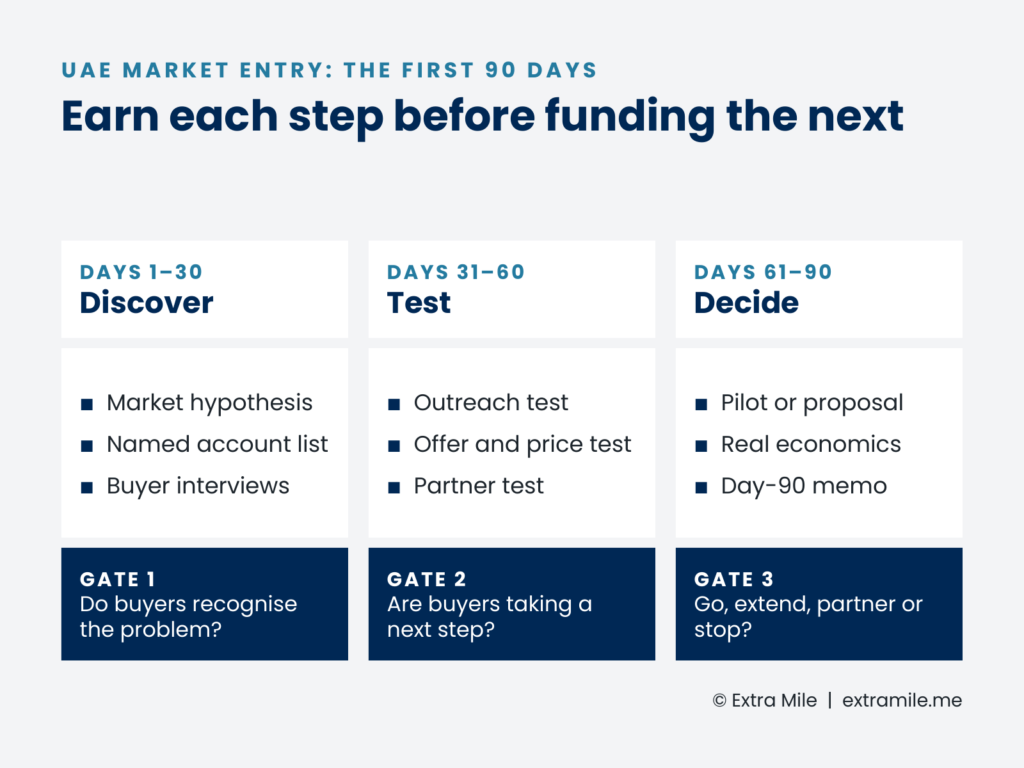
UAE market entry for a B2B SaaS company should begin with 90 days of evidence, not an office lease. Split the quarter into three 30-day sprints (discover, test, decide), put a go/no-go gate at the end of each, and check the dates against the UAE calendar before you start. By day 90 you should know whether to license, hire and commit, or stop with most of your budget still in the bank.
In this article
- Why the first 90 days decide UAE market entry
- Check the calendar before you start
- Days 1–30: Discover
- Days 31–60: Test
- Days 61–90: Decide
- The go/no-go gates
- What day 90 should produce
- Sources and further reading
Why the first 90 days decide UAE market entry
The UAE is a busy place to sell software. Dubai attracted 1,253 greenfield FDI projects in 2025, up 10.5% on 2024, and ranked first worldwide for headquarters projects for the fourth year running, according to fDi Markets data published by the Government of Dubai Media Office. Dubai Chamber of Digital Economy says it helped 1,690 digital start-ups set up or expand in Dubai in 2025, and 75% of them were international companies.
That cuts both ways. Some of your existing global customers probably run their regional headquarters from Dubai, which gives you warm doors on day one. But your UAE buyers are also hearing from plenty of new vendors that arrived the same year you did.
Buyers are confident. In PwC’s 29th Global CEO Survey, 91% of UAE CEOs expected economic growth in the country to strengthen over the next 12 months. Confidence doesn’t put your product in next year’s budget, though, and conditions can move fast. The UAE Economic Graph Report 2026, based on LinkedIn member data, found hiring stayed above 2019 levels throughout 2025, then went through a volatile start to 2026 before improving by June.
So the plan has two jobs: find real demand quickly, and give you a clean way to stop. This article zooms into the UAE. For the wider regional view, including market selection and routes to market, see our practical GCC market entry plan. And if you haven’t yet settled whether to enter the UAE or Saudi Arabia first, do that before day one.
Check the calendar before you start
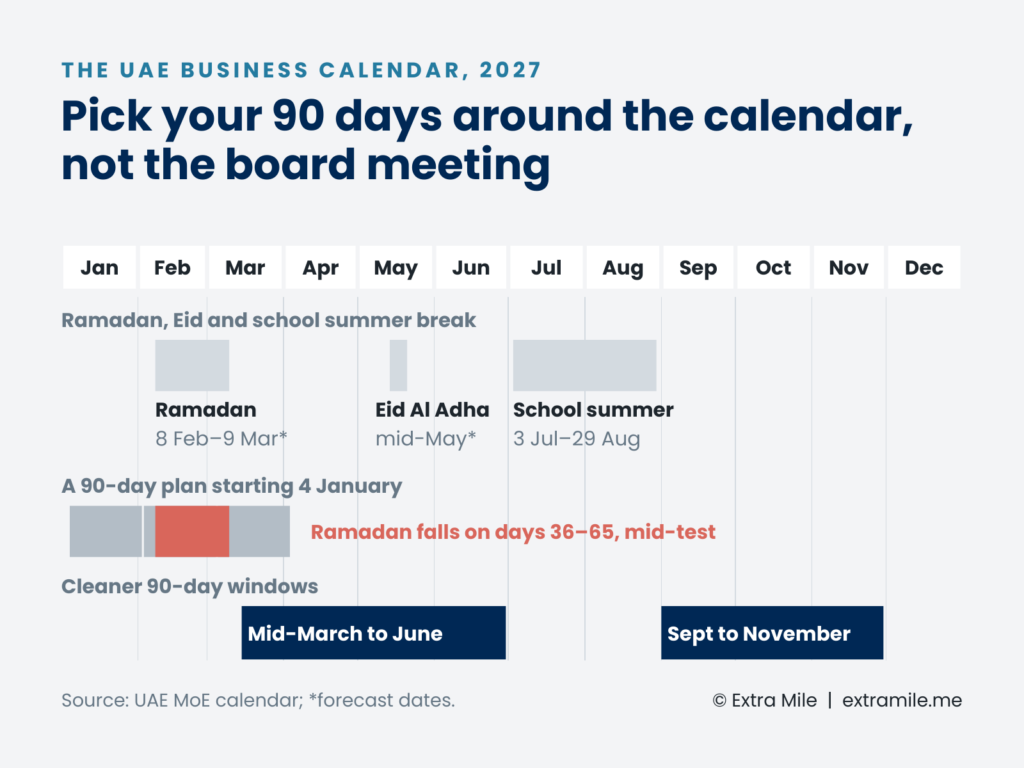
Most 90-day plans are drawn as 13 identical weeks. In the UAE, three periods in 2027 change how much selling you can actually do:
- Ramadan is expected to run from about 8 February to 9 March 2027, subject to moon sighting. In 2026 the Ministry of Human Resources and Emiratisation cut private-sector working hours by two a day for the month. Business carries on, with shorter days.
- Eid Al Adha is expected on 16 or 17 May 2027, with public holidays around it.
- School summer break: schools on the Ministry of Education calendar finish on 2 July 2027, and the next school year starts on 30 August. Plan for thinner diaries while schools are out.
There’s also the event calendar. GITEX Global moved to December from 2026, so the year now ends with the region’s biggest tech week. Good for a final round of meetings. Not a substitute for pipeline.
Now do the maths. A plan that starts on 4 January 2027 puts Ramadan on days 36 to 65, right across the test sprint. That doesn’t sink the plan. It means front-loading outreach in January, booking your in-person week for mid-March, and using Ramadan for partner conversations, pricing work and follow-up. The cleaner windows in 2027 are mid-March to June, and September to November.
Days 1–30: Discover
The first sprint has one goal: a sharp hypothesis, and proof that buyers recognise the problem.
Name one owner. A founder, CRO or senior commercial lead with protected time each week and the authority to stop the project. Market entry run as a side project of the global sales team tends to drift.
Write a one-page hypothesis. The segment, the problem, the buyer roles, why the UAE now, and what evidence would prove you wrong.
Build the named account list. Start with existing global customers that run regional offices in Dubai or Abu Dhabi, then add look-alike UAE accounts. The account and interview targets in our GCC guide still apply here.
Interview buyers by video before you fly. Add a few UAE-specific questions to your usual discovery:
- Where does customer data need to be hosted, and who signs that off?
- Which local systems would we need to integrate with?
- How do you buy software like ours: direct, through a reseller or through a procurement platform?
- What currency and payment terms would you expect?
- Who else are you talking to?
Gate 1 (day 30): buyers describe the problem in their own words, and some conversations go further than politeness. An introduction to a colleague, a shared requirement, a request for pricing. If every call stays friendly and vague, narrow the segment or stop.
Days 31–60: Test
Sprint two turns interest into behaviour. Run three small tests at the same time.
- Outreach test. A focused sequence to the named accounts, on LinkedIn and email, from a real person rather than a company account. Track replies and meetings, and read what people actually say.
- Offer test. Put a real proposal in front of the warmest accounts: pilot scope, price in AED, payment terms. Polite interest in a deck tells you little. A buyer negotiating your price tells you a lot.
- Partner test. One partner, one real account. If the partner can’t get you into that account within the sprint, you’ve learned something important before signing anything.
Then spend a week in the UAE. Stack the meetings into one trip, covering Dubai and Abu Dhabi if your accounts are split, and focus on the buyers who’ve already engaged. Turning up in person after a month of video calls tends to move conversations on.
Gate 2 (day 60): qualified opportunities with a buyer-led next step, such as a technical review, a pilot discussion or an introduction to procurement. Plus at least one real conversation that came through the partner.
Days 61–90: Decide
Sprint three is about the decision, not the deal count.
- Move the best opportunities to pilot or proposal. Don’t chase signatures just to hit a number.
- Build the economics from what you saw: sales cycle, effort per opportunity, price acceptance, partner margin and delivery cost.
- Get local advice on the licence. Free zone or mainland, and which emirate, depends on who you sell to and how you invoice. It’s a legal and tax question, so treat it as one.
- Decide who sells next: the founder for another quarter, a partner, or a first hire.
Gate 3 (day 90): go, extend, partner or stop.
The go/no-go gates
Write the gates down before you start, and agree them with whoever controls the budget. Thresholds set in advance are much harder to argue away on day 89.
| Gate | Question | Evidence to move on | If it’s missing |
|---|---|---|---|
| Day 30 | Do buyers recognise the problem? | Buyers describe it unprompted; introductions or shared requirements | Narrow the segment or stop |
| Day 60 | Are buyers taking a next step? | Buyer-led next steps; one partner-sourced conversation | Rework the offer or change the route |
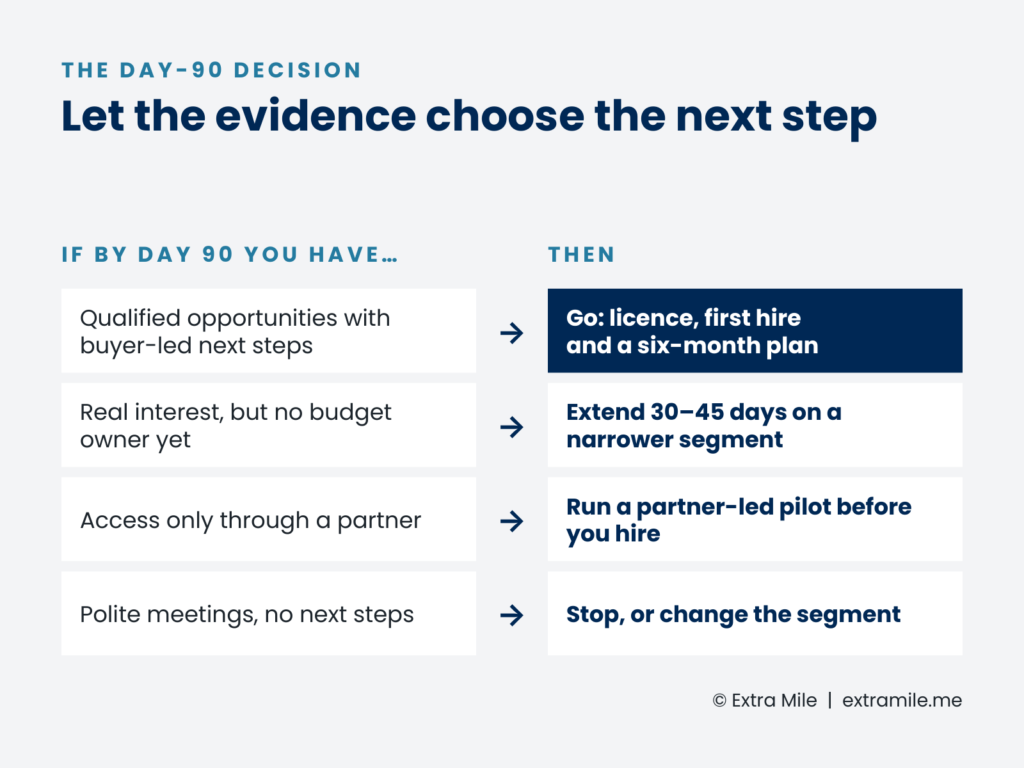
| Day 90 | Do the economics work? | Opportunities at pilot or proposal stage; a credible cost to win | Extend, run a partner-led pilot or stop |
Calibrate the numbers behind each gate to your deal size: fewer, deeper opportunities for enterprise products, more volume for lower-priced ones. What matters is that the evidence, not the sunk cost, chooses the next step.
What day 90 should produce
A one-page decision memo, signed off by the budget owner. It covers:
- the segment and the named accounts you’ll pursue
- the evidence from each gate
- the route to market and who sells
- the licence and set-up steps, with local advice attached
- a six-month budget and milestones
- the stop rule for the next phase
If the answer is stop, the 90 days still paid for themselves. You found out for the cost of a quarter of focused work, not a year of salaries and rent.
Planning UAE market entry for 2027 and want a second pair of eyes on the plan or the gates? Discuss your GCC expansion with Extra Mile.
Sources and further reading
- Government of Dubai Media Office: Dubai ranks No.1 globally for greenfield FDI projects in 2025 (fDi Markets data), June 2026
- Government of Dubai Media Office: Dubai Chamber of Digital Economy supported 1,690 digital start-ups in 2025, January 2026
- PwC Middle East: 29th Global CEO Survey, UAE findings, January 2026
- WAM: UAE Economic Graph Report 2026 (LinkedIn with the Ministry of Foreign Trade), August 2026
- Ministry of Human Resources and Emiratisation: Ramadan working hours for the private sector, February 2026
- UAE Ministry of Education: Academic calendar 2026–2027
- Khaleej Times: Ramadan, Eid Al Fitr and Eid Al Adha 2027 likely dates
- Government of Dubai Media Office: GITEX Global moves to Expo City Dubai and December dates, October 2025